

STAHL+TECHNIK
STAHL + TECHNIK
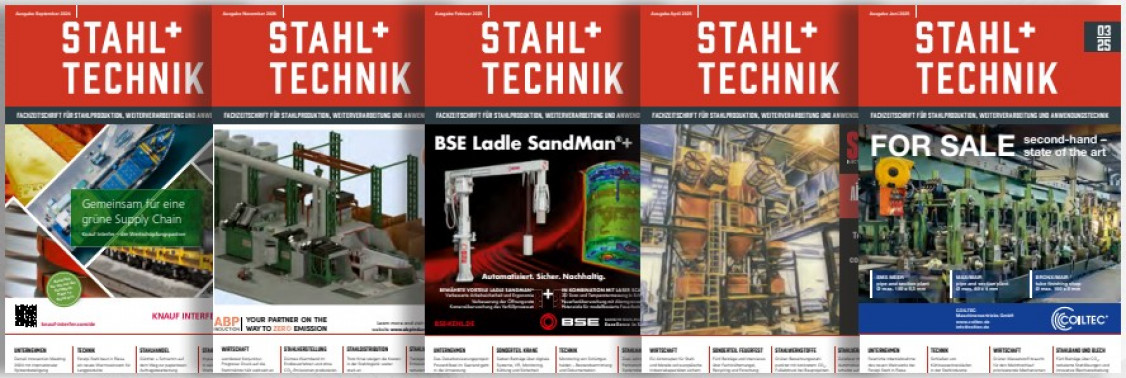
STAHL + TECHNIK is the German-language trade journal for steel production, processing, application technology, innovation and management.
The target groups are steel production companies, steel processing companies (from hot and cold rolling to surface finishing), steel processing companies (forming, joining, sheet metal processing), the supply industry, universities, technical colleges and associations.
Content:
Plant engineering; Metallurgy; Innovation; Coke-making technology; Technology; Companys; Markets; Forming technology; Materials and production, Digitization; Steel application; Precious metals
Categories:
Steel trade; Management; Events; Profession and career; Energy and Environment; Technology, strategy and management trends; Profiles of the industry players; Comments; Interviews; Well-founded technical reports; Scientific background information
Frequency of publication: 3 issues 2026
8th year of publication
Print run: 5,000 copies
Dates and planned topics 2026
ALL Ad closing dates | Publication dates
Issue 1 Issue 2 Issue 3 Issue 4-5 Issue 6
Publication date 02-10-2026 04-07-2026 05-05-2026 09-08-2026 11-03-2026
Advertising deadline 01-20-2026 03-17-2026 04-21-2026 08-18-2026 10-13-2026
Editorial programme 2026
Issue 1 - February 2026
Ad closing date: 20 January | Printing material: 22 January | 10 February
With its Digital Hub, the SMS group is setting a new milestone on the path to fully autonomous production in the metal industry. The new system combines over 300 industrial software applications and third-party applications on a single platform. The goal is holistic process optimization: increased productivity and efficiency for entire production routes while offering superiority over stand-alone solutions in terms of data flows, workflows, rules, and interoperability. Uniform, customizable user interfaces create cross-process transparency while minimizing the total cost of ownership for the automation and software landscape. The long-term goal is the “lights-out factory” – secure, self-optimizing, and remotely controlled metal production.
- Preview of the 2026 Crane Conference, which will take place on March 16-17 at Ruhr University Bochum under the motto “Megatrend AI. Will cranes soon develop and operate themselves?”
- Heavy-duty cranes from Danieli for current transformation projects: Stahl-Holding-Saar is equipping the two new electric steelworks being built in Dillingen and Völklingen with modern 4-bridge cranes. In Austria, voestalpine is investing in an automated scrap yard management system at its Donawitz GmbH site.
In order to continue actively shaping market developments in a dynamically changing environment, Knauf Interfer has reorganized its Steel business unit with a new structure and significant investments. In future, the Steel business unit will comprise two divisions. The product ranges, expertise, and logistics capacities of the Steel Service Center, the plate cutting facility, and the Benelux sales office will be bundled in the Steel Service division. The Functional Metals division will focus on the production and finishing of cold-rolled strip.
In precision pipe manufacturing, every detail counts—especially the shape of the strip edge that will later be welded. Even the smallest deviations in angle or height can disrupt the welding process and cause rejects. Until now, these deviations often only became apparent at the end of the production line—too late to take corrective action in time. With a newly developed, high-precision real-time measurement and visualization system called ConScan®, tube manufacturers can now check their strip edges during processing. This saves time, reduces material scrap, and ensures greater process reliability. One of the first users of the new technology is Schoeller Werk GmbH & Co. KG, which has successfully integrated ConScan® into its production.
Kranfachtagung, Bochum/Germany - 16.-17.03.2026
LogiMAT, Stuttgart/Germany - 24.-26.03.2026
Issue 2 - April 2026
Dates:
Ad closing date: 17 March| Printing material: 19 March| Publication date: 07 April
Editorial program
Outlook for the wire 2026 and Tube 2026 trade fairs
In 2026, Düsseldorf will once again be the global meeting place for the international wire, cable, and tube industries. On April 13, 2026, the world's leading trade fairs for the international wire, cable, and tube industries, wire and Tube, will open their doors in Düsseldorf. Until April 17, the Düsseldorf Exhibition Center will become the world's leading hotspot for these industries. More than 2,700 exhibitors from 65 countries will present technologies, machines, materials, and end products on around 120,000 square meters of exhibition space, covering the entire industrial value chain. The focus will be on machines and equipment for wire, cable, and tube production, new materials, efficient production processes, and high-quality end products.
Steel production / Plant engineering
Aperam stainless steel plant in Genk increases reliability after comprehensive upgrade
Aperam, a global supplier of stainless steel and specialty steels, has successfully completed a major investment project at its Genk site in Belgium. The project involved the modernization of an existing 130-ton AOD converter and the installation of a new one, significantly increasing production flexibility. Advanced dust extraction systems have significantly reduced emissions. A heat recovery system now ensures maximum energy efficiency. Following the comprehensive upgrade, the stainless steel plant is now operating more reliably than before.
Grid-friendly power supply at BGH Edelstahl Siegen
An Active Power Feeder from Primetals Technologies was installed to connect the electric arc furnace to the grid. The technology is based on a modular multilevel converter (MMC) for medium-voltage applications in combination with an innovative control system. The solution reduces negative effects on the public power grid and increases the efficiency of furnace operation. The first tests with the innovative power supply were carried out as planned and were successful.
Innovative cooling for rolling long products
The water boxes in the “BlueBox” series were developed as a forward-looking solution for the controlled cooling process of long products. Designed as single or multi-strand water boxes with reduced space requirements, the new generation of cooling lines includes a range of innovative features that are embedded in an overall concept for temperature-controlled cooling of bar steel and coil products.
Retrofit of burners for heating hoods in annealing systems
In hood annealing systems, the heating hood has a decisive influence on energy consumption, emissions, and operational safety. The most obvious lever is higher combustion air preheating, but the limit values for NOx emissions must be observed. Tenova THSQ burners were developed as low-NOx burners for heating hoods and are designed for high air preheating up to 600 °C (typical heating hood outputs) and for installation in narrow annular gaps. This article summarizes the motivation, burner concept, and field results at a German customer's site, as well as a practical approach for retrofit projects.
New decanter technology for sludge dewatering
Modular, efficient, user-friendly—that's how Flottweg describes its new decanter. The focus of this new development is on a noticeable increase in performance. The machine is not only more efficient, but also consumes less energy. Flottweg is thus responding to growing market demands for higher throughput rates, better separation results, and more sustainable operating modes.
Pipes
The Rhine water transport pipeline – one of the most important environmental projects in Germany
With the end of coal-fired power generation and lignite mining, the two opencast mining lakes Garzweiler and Hambach are to be created in the Rhineland mining area. A 45 km long supply line consisting of several strands will be built to fill the open-cast mines and irrigate wetlands. As part of this project, which is being carried out by RWE, Tosçelik Spiral is supplying a total of around 9,000 spiral-welded large pipes with a diameter of 2,235 mm.
Steel processing and distribution
Collaboration between VOLVO Cars and Salzgitter AG as a practical example of circular economy
Last year, Volvo Cars and Salzgitter AG expanded their long-standing collaboration and launched a closed-loop partnership. The Salzgitter Group supplies Volvo Cars' body parts plant in Sweden with high-quality flat steel. Significant quantities of steel scrap from the Swedish press shop are returned to Salzgitter and recycled here as input material in steel production. The project, called ScanLoop, is an example of the implementation of a circular economy to achieve business and, above all, sustainable benefits.
and much more
Trade Fairs| Exhibitions| Events
AWT Conference, Aachen - April 14-15, 2026
Freiberg Refractories Symposium, Freiberg - April 20-22, 2026
HANNOVER Messe, Hanover - April 20-24, 2026
AISTech, Pittsburgh/USA - May 4-6, 2026
Surface Technology, Stuttgart - May 5-7, 2026
Duplex World Conference & Expo, Rotterdam/Netherlands – May 6–7, 2026
Issue 3 - June 2026
Dates:
Ad closing date: 21 April| Printing material: 23 April| Publication date: 05 May
STEEL PRODUCTION / PLANT ENGINEERING
thyssenkrupp Steel Expands Its Metallurgical Laboratory for Iron Ore
As part of its transition to climate-neutral steel production, thyssenkrupp Steel is investing in a new testing laboratory at its Duisburg Schwelgern site. The facility expands the existing testing capabilities of the metallurgical laboratory and enables ISO-compliant testing of feedstocks for the future direct reduction plant (DR plant). The new DR laboratory ensures that the quality of feedstocks for future hydrogen-based production is guaranteed from the very beginning.
High-Power Electric Heaters as a Carbon-Free Alternative to Gas Burners
The “HyperTherm” research project aims to validate high-temperature electric technology under the demanding conditions of bulk forming. The focus is on developing a scalable retrofit solution that allows existing forging furnaces to be efficiently converted to high-power electric operation at temperatures up to 2000 °C. HyperTherm is a joint project between the technology startup HyperHeat and the Institute for Industrial Furnace Engineering and Thermal Technology (IOB) at RWTH Aachen University.
Smart video systems enhance efficiency and safety in steel production
Digital technologies such as AI-based network cameras can help companies avoid production disruptions and secure safety-critical processes more efficiently. A look inside the ArcelorMittal Gent steelworks in Belgium demonstrates how this works in practice. Network cameras combined with AI applications monitor production processes in real time, ensure quality, and enhance safety in high-risk areas. The systems help reduce downtime, standardize procedures, and ease the workload on employees.
MATERIAL HANDLING: CRANES, INDUSTRIAL VEHICLES, LIFTING AND STORAGE TECHNOLOGY
When standard cranes reach their limits
High-performance cranes are specifically designed for applications where heavy loads must be moved in continuous operation and under extreme conditions, such as in steel mills, rolling mills, and foundries. These high-performance cranes are not only characterized by an extremely robust design, but also enable a high degree of automation: All processes can be intelligently networked and precisely controlled. Designed as a comprehensive solution from a single source, the focus is on process optimization and maximum availability in continuous operation.
Heavy-Duty Compact Forklifts for Coil Transport
A new compact forklift called the M-Tex is designed for load capacities ranging from 11 to 15 tons. These forklifts offer clear advantages wherever heavy loads need to be transported in confined spaces. Compared to conventional heavy-duty forklifts, they are up to 25% narrower and 20% shorter, making them ideal for tight spaces where standard models fall short.
Transport of Slag Buckets – 170 Tons of Liquid Slag at 1,500°C
Transporting liquid slag in steel mills is a demanding task that places enormous demands on vehicle technology and drivers. An Indian steel mill is using one of the world’s largest slag bucket transporters ever built, with a payload of 170 tons: a new heavy-duty transporter equipped with a fully automatic Allison 4000-SP transmission. The new acquisition boosts productivity, reduces downtime, and thus contributes significantly to efficient fleet management.
Efficient Handling of Sheet Metal Blanks with Vacuum Tube Lifters
When loading and unloading thin sheet metal blanks measuring up to 2 m x 3 m into a processing machine, the challenge is to ensure that the sheets remain undamaged and do not bend. At LO-CAT SYSTEMS GmbH, a single employee can effortlessly and precisely guide sheet metal parts weighing up to 60 kilograms into the machine. Reducing manual effort creates an ergonomic and safe workplace.
STEEL PROCESSING AND DISTRIBUTION
Infrastructure solutions for major projects by Deutsche Bahn and Swiss Federal Railways
With contracts from Deutsche Bahn and Swiss Federal Railways for rails, switches, and signaling technology, voestalpine is underscoring its leading position as a systems provider in the railway infrastructure sector. The range of services includes the supply of rail and switch systems as well as signaling technology and monitoring services.
New Stainless Steel Powder for Additive Manufacturing in Aerospace Applications
Outokumpu, in collaboration with MT Aerospace, has made significant progress in additive metal powder manufacturing. As a result of the partnership, a modified 316L stainless steel powder has been developed that is specifically designed for aerospace applications. With this project, Outokumpu and MT Aerospace are demonstrating how new levels of performance can be achieved in metal powder technology.
and much more
Trade Fairs| Exhibitions| Events
- VDEh-Stahltag, Hattingen/Germany - May 21, 202621
- 10th International Conference on Hot Sheet Metal Forming of High Performance Steel, Pilsen/Czech Republic - June 1-3, 2026
- Sensor + Test, Nuremberg/Germany - June 9-11, 2026
- Osnabrücker Leichtbautage, Osnabrück/Germany - June 10-11, 2026
Issue 4-5 - September 2026
Dates:
Ad closing date: 18 August| Printing material: 20 August| Publication date: 08 September
A challenging economic environment, geopolitical disruptions, and growing uncertainties are shaping metallurgical plant engineering. For Till Schreiter, CEO of ABP Induction, one thing is clear: the challenges are not new—but they have been underestimated for too long. In the interview, he identifies structural deficits in Europe while also highlighting where the key levers for competitiveness and growth lie. He calls on industry and companies to demonstrate greater consistency, innovative strength, and strategic courage.
ABB and SMS group have entered into a partnership to jointly further develop an electromagnetic flow control system for the continuous casting of thin and medium slabs. The goal is to optimize the energy balance of continuous casting processes, increase productivity, enable greater flexibility in the product portfolio and steel grades—including the premium segment—and achieve improved surface quality in the production of low-carbon steels.
With the successful commissioning at Zhongshou Special Steel, Arvedi ESP technology has reached a major milestone. Featuring four roughing stands and five finishing stands, it is currently the most powerful and productive Arvedi ESP plant worldwide and at the same time the eleventh installation of this kind. In China, endless hot-rolled coils (eHRC) have transformed the market for hot and cold strip.
At the Fraunhofer Institute for Mechanics of Materials IWM in Freiburg, a new simulation model has been developed to achieve a desired microstructure in open-die forging. Through simulation, weak points in forged components—caused by incomplete grain recrystallization—can be predicted in advance. Embedded in an efficient digital workflow, this results in a virtual forging laboratory that enables material and energy savings in forging processes.
The Hergarten Group is making a clear statement for future viability and sustainable growth. The logistics service provider specializing in general cargo has launched the full electrification of its vehicle fleet. As part of the “E-Mission 2031” project, all vehicles are to be replaced by emission-free electric trucks over the next five years.
In almost every company, manual warehouses are an indispensable part of material supply—even where automated warehouses are in use. KASTOlogic mobile digitally maps manual warehouse processes and makes them structured and transparent—regardless of whether an automated warehouse is present. The app runs on mobile devices and supports all processes—from storage and picking to quality control.
With the “reECONIC” concept vehicle, Daimler Truck demonstrates how principles of the circular economy can be implemented in the industrial production of commercial vehicles. The battery-electric vehicle was developed together with 33 partners with the aim of significantly increasing the use of recycled materials while fully meeting requirements for safety, durability, and performance. In addition, CO₂ emissions in vehicle production could be reduced by up to 36 percent. Steel plays a key role here. ArcelorMittal supplied recycled and renewably produced steel for key structural components of the vehicle. The steel for the axle was produced at Saarstahl Ascoval’s electric steel plant in France, and further processed into bar steel at the Saarstahl site in Völklingen.
With Armox® 500 AM Powder, SSAB is launching the world’s first armor steel powder and demonstrating how 3D printing can provide protection where armor plates are not optimal. SSAB supplies the armor steel powder for additively manufactured components with properties equivalent to those of armor plate. This unique powder has already attracted interest from key customers.
Presses require a great deal of space, and the operating and investment costs for machines and tools are enormous. Is there truly no alternative to presses for manufacturing precision components? Researchers at the Fraunhofer IWU and their partners have now demonstrated that complex precision components can in the future be produced using hollow embossing rolling without any loss of quality and with up to 70 percent lower costs.
Steel production at the historic site in southern Duisburg will continue. Hüttenwerke Krupp Mannesmann will become a wholly owned subsidiary of Salzgitter AG after the two co-shareholders, thyssenkrupp Steel Europe and Vallourec, announced their intention to withdraw from the joint venture.
Trade Fairs | Exhibitions| Events
EuroSteel, Krakau/Poland -16.-18.09.2026
METAL, Kielce/Poland - 22.-24.09.2026
EuroBLECH, Hanover/Germany - 20.-23.10.2026
Issue 5 - November 2026
Ad closing date: 13 October| Printing material: 15 October | Publication date: 03 November
Trade Fairs| Exhibitions| Events
Contact
Ad sales
Editorial staff | Manuscript submission
Sales and Marketing
Susett Bendel
P: +49 211 1591-167
E-Mail: susett.bendel@dvs-media.info